
Phonics Worksheets
Printable phonics worksheets that follow the order most early reading programmes teach: beginning sounds, short vowels in CVC words, word families, consonant digraphs and silent e. Each sheet has clear instructions and an answer key, and the word lists and flashcards give extra practice for reading at home or in class.
- Instant download
- Editable Word & Excel
- Print-ready PDF
- 7-day refund
8 files · PDF, DOCX, XLSX
Phonics Worksheets Pack
Printable phonics worksheets with answer keys (beginning sounds, short vowel CVC words, word families, digraphs, silent e), word lists, flashcards and an Excel reading progress tracker.
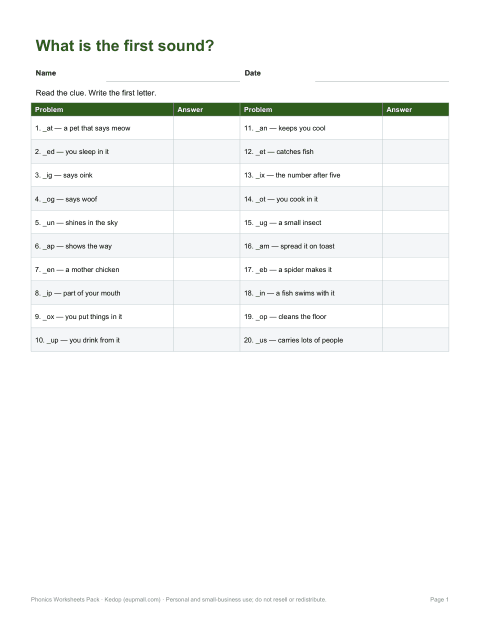
- Beginning sounds (PDF, DOCX)
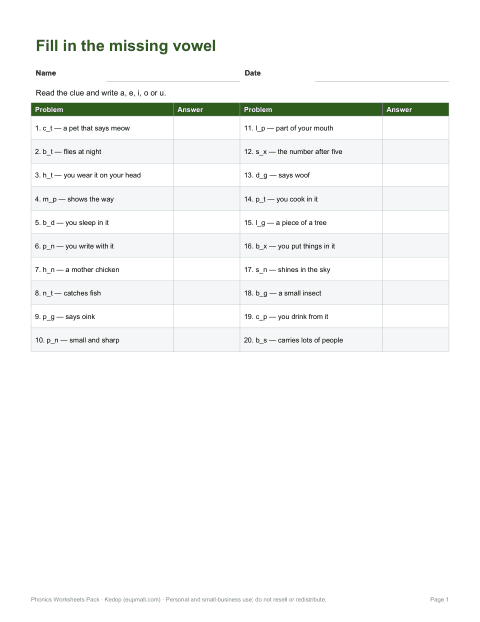
- Missing vowel (PDF, DOCX)
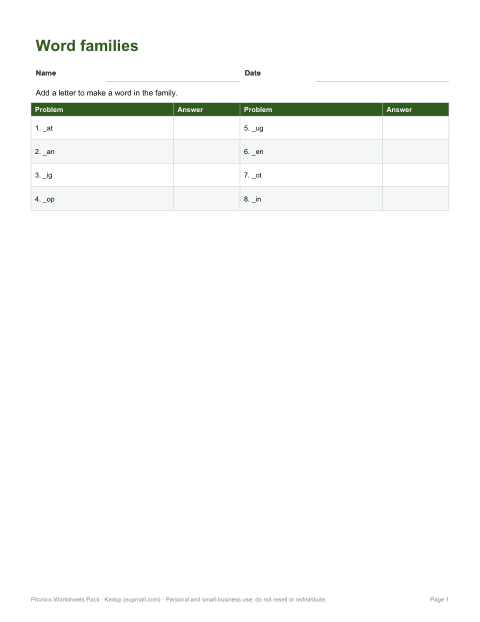
- Word families (PDF, DOCX)
- + 5 more
$5.00 USD, one-time 8 files · about $0.63 each
- Instant download
- 7-day refund
- Secure checkout by Stripe
7-day money-back guarantee. Full refund within 7 days of purchase, even after you download.
Free sample: Beginning Sounds (PDF, 60 KB)
Phonics Worksheets Pack
Printable phonics worksheets with answer keys (beginning sounds, short vowel CVC words, word families, digraphs, silent e), word lists, flashcards and an Excel reading progress tracker.
- Beginning sounds (PDF, DOCX)
- Missing vowel (PDF, DOCX)
- Word families (PDF, DOCX)
- Digraphs (PDF, DOCX)
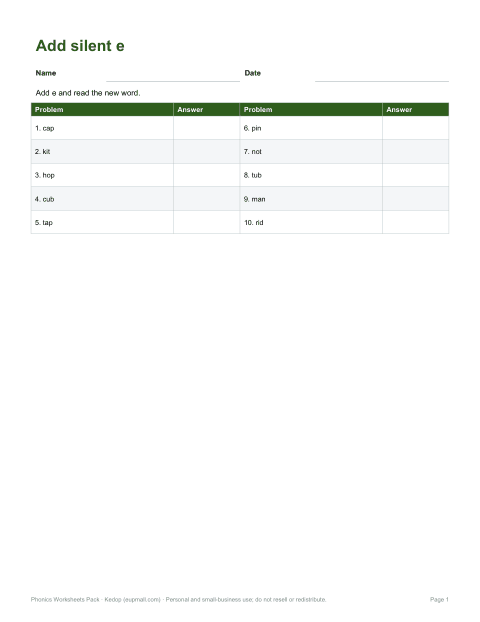
- Silent e (PDF, DOCX)
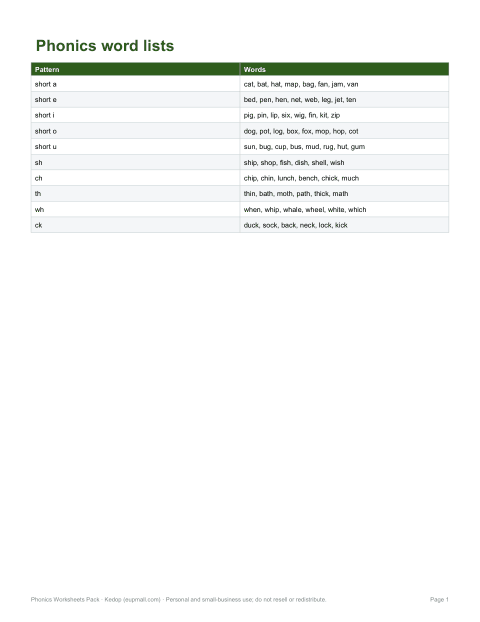
- Word lists (PDF/DOCX)
- Flashcards (PDF)
- Progress tracker (XLSX)
Formats: PDF, DOCX, XLSX. Instant download after payment (link valid 72 hours, up to 5 downloads). AI-assisted: the templates were drafted with AI help and reviewed and laid out before publishing.
$5.00 USD, one-time 8 files · about $0.63 each
- Instant download
- 7-day refund
- Secure checkout by Stripe
7-day money-back guarantee. Full refund within 7 days of purchase, even after you download.
Free sample: Beginning Sounds (PDF, 60 KB)
Full refund within 7 days — see the refund policy and license.
Free printables
Single sheets you can print right now, no sign-up. The full pack adds every sheet in one download plus the editable files.
 Beginning Sounds Worksheets2 pages · free PDF
 Missing Vowel Phonics Worksheet2 pages · free PDF
 Printable Word Families Worksheet2 pages · free PDF
 Printable Digraphs Missing Letter Worksheet2 pages · free PDF
 Silent e Word Practice Worksheet2 pages · free PDF
 Printable Phonics Word Lists1 page · free PDF
 Printable Phonics Flashcards PDF2 pages · free PDF
 Printable Phonics Progress Tracker2 pages · free PDF
What is in the pack
| Worksheet | Skill |
|---|---|
| Beginning sounds | Identify the first sound of a word |
| Short a, e, i, o, u CVC words | Fill in the missing vowel |
| Word families | -at, -an, -ig, -op, -ug |
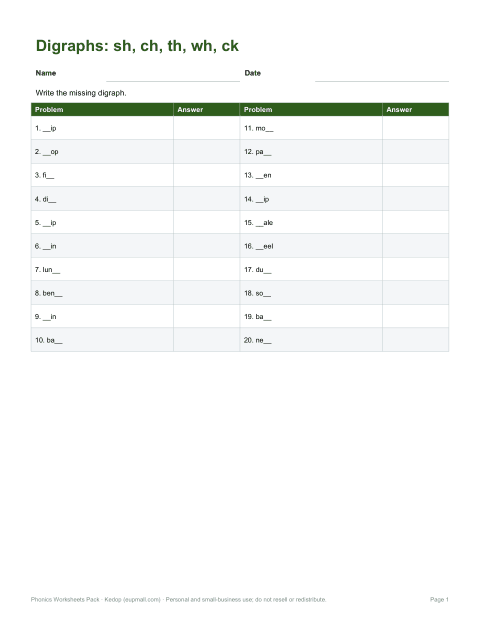
| Digraphs | sh, ch, th, wh, ck |
| Silent e (magic e) | cap → cape, kit → kite |
| CVC word lists | Reading practice by vowel |
| Phonics flashcards | Quick daily review |
A typical phonics sequence
- Letter sounds, starting with common letters (s, a, t, p, i, n).
- Blending sounds into CVC words: c-a-t, cat.
- All five short vowels in CVC words.
- Consonant digraphs: sh, ch, th, wh, ck.
- Consonant blends: st, bl, tr, fr.
- Silent e and long vowel sounds.
- Vowel teams: ee, ai, oa, and more.
Programmes differ in order and pace; follow your school’s sequence and use the worksheets that match what your child is learning.
CVC words by vowel
| Vowel | Example words |
|---|---|
| short a | cat, bat, hat, map, bag, fan, jam, van |
| short e | bed, pen, hen, net, web, leg, jet, ten |
| short i | pig, pin, lip, six, wig, fin, kit, zip |
| short o | dog, pot, log, box, fox, mop, hop, cot |
| short u | sun, bug, cup, bus, mud, rug, hut, gum |
Digraph word lists
| Digraph | Words |
|---|---|
| sh | ship, shop, fish, dish, shell, wish |
| ch | chip, chin, lunch, bench, chick, much |
| th | thin, bath, moth, path, thick, math |
| wh | when, whip, whale, wheel, white, which |
| ck | duck, sock, back, neck, lock, kick |
A digraph is two letters that make one sound. “ck” only appears at the end of a word or syllable after a short vowel.
How to use phonics worksheets well
- Say the sounds aloud together before writing.
- Tap or clap each sound as you blend.
- Keep sessions short — 10 minutes is plenty for young children.
- Read the finished words back, then use them in a sentence.
- Mix worksheets with games, magnetic letters and decodable books.
- Praise effort and accuracy, not speed.
Blending and segmenting
Two skills sit at the heart of phonics. Blending is putting sounds together to read a word: /s/ /u/ /n/ → sun. Segmenting is breaking a spoken word into sounds to spell it: ship → /sh/ /i/ /p/. Practise both aloud before writing: stretch words slowly like a rubber band, tap one finger for each sound, or push a counter into a box for each sound (Elkonin boxes). Children who can hear the separate sounds find the worksheets much easier.
Tricky words
Some very common words do not follow the patterns children have learned yet — the, said, was, you, they. Teach these as “tricky” or “heart” words: notice which part is regular and which part must be remembered by heart. Keep a small set on flashcards alongside the phonics cards and practise a few each day.
Signs a child is ready to move on
- Reads CVC words smoothly without sounding out every letter aloud.
- Can spell simple words by segmenting sounds.
- Recognises the digraphs taught so far in new words.
- Reads short decodable sentences with understanding.
Worked example
A child learning short vowels completes the “missing vowel” sheet: c_t becomes cat, b_d becomes bed, p_g becomes pig. The adult checks with the answer key, notices two errors with short e and short i, and uses the CVC word list flashcards for those two vowels the next day before moving on.
Formats
Print-ready PDF worksheets with answer keys (US Letter; A4 with “Fit to page”), Word versions of the word lists and an Excel reading progress tracker.
Frequently asked questions
What age are phonics worksheets for?
Mostly ages 4–7, from pre-K to first grade.
What is a CVC word?
A consonant–vowel–consonant word such as cat, bed or sun.
What is a digraph?
Two letters that make one sound, such as sh, ch or th.
Do the worksheets have answer keys?
Yes, every worksheet includes one.
Was AI used to create the worksheets?
Worksheets were generated by script and instructions drafted with AI assistance, then reviewed before publishing.